Monday, November 13, 2017
Kindergarten Program Practice!
Kiddos can use this PowerPoint with the music embedded to practice the words along with the music while at home!

Saturday, October 14, 2017
Musical Research: Why is Music important?
Oftentimes, people wonder why music education is part of a child's education. Why do they have to learn to sing and dance? Why are they learning to read music if they probably won't ever use it again? Isn't music just a place where they can have fun and play? There are many answers to these questions, and I like to share research with those interested every now and then. If you are one of those interested, I encourage you to look into the research done with music and the brain; I promise, there is a lot! Following are just a few ways music can help your children in all other aspects of their school life, and part of why it is so important that they learn it!
Excerpt taken from Susan Hallam's "The Power of Music: Its Impact on the Intellectual, Social and Development of Children and Young People"
"Perceptual, Language, and Literacy Skills
Speech and music have a number of shared processing systems. Musical experiences which enhance processing can therefore impact on the perception of language which in turn impacts on learning to read. Active engagement with music sharpens the brain’s early encoding of linguistic sound. Eight year old children with just 8 weeks of musical training showed improvement in perceptual cognition compared with controls. Speech makes extensive use of structural auditory patterns based on timbre differences between phonemes. Musical training develops skills which enhance perception of these patterns. This is critical in developing phonological awareness which in turn contributes to learning to read successfully. Speech processing requires similar processing to melodic contour. Eight year old children with musical training outperformed controls on tests of music and language. Learning to discriminate differences between tonal and rhythmic patterns and to associate these with visual symbols seems to transfer to improved phonemic awareness. Learning to play an instrument enhances the ability to remember words through enlargement of the left cranial temporal regions. Musically trained participants remembered 17% more verbal information that those without musical training. Children experiencing difficulties with reading comprehension have benefitted from training in rhythmical performance.
Numeracy
Research exploring the relationships between mathematics and active musical engagement has had mixed results, in part, because not all mathematics’ tasks share underlying processes with those involved in music. Transfer is dependent on the extent of the match, for instance, children receiving instruction on rhythm instruments scored higher on part-whole maths problems than those receiving piano and singing instruction.
Intellectual Development
Learning an instrument has an impact on intellectual development, particularly spatial reasoning. A review of 15 studies found a ‘strong and reliable’ relationship, the author likening the differences to one inch in height or about 84 points on standardised school tests. A study contrasting the impact of music lessons (standard keyboard, Kodaly voice) with drama or no lessons found that the music groups had reliably larger increases in IQ. Children in the control groups had average increases of 4.3 points while the music groups had increases of 7 points. On all but 2 of the 12 subtests the music group had larger increases than control groups.
General Attainment and Creativity
There is a consistent relationship between active engagement in music and general attainment but much research has been unable to partial out confounding factors. A recent study, adopting more sensitive statistical modelling overcame these difficulties. Two nationally representative data sources in the USA with data from over 45,000 children found that associations between music and achievement persisted even when prior attainment was taken into account. Music participation enhances measured creativity, particularly when the musical activity itself is creative, for instance, improvisation.
Personal and Social Development
General attainment may be influenced by the impact that music has on personal and social development. Playing an instrument can lead to a sense of achievement; an increase in selfesteem; increased confidence; persistence in overcoming frustrations when learning is difficult; self-discipline; and provide a means of self-expression. These may increase motivation for learning in general thus supporting enhanced attainment. Participating in musical groups promotes friendships with like-minded people; selfconfidence; social skills; social networking; a sense of belonging; team work; self-discipline; a sense of accomplishment; co-operation; responsibility; commitment; mutual support; bonding to meet group goals; increased concentration and provides an outlet for relaxation. Research in the USA on the benefits of band participation found that 95% of parents believed that participation in band provided educational benefits not found in other classrooms. Working in small musical groups requires the development of trust and respect and skills of negotiation and compromise. In adolescence music makes a major contribution to the development of self-identity and is seen as a source of support when young people are feeling troubled or lonely. 3 Music has been linked to the capacity to increase emotional sensitivity. The recognition of emotions in music is related to emotional intelligence. Increasing the amount of classroom music within the curriculum can increase social cohesion within class, greater self-reliance, better social adjustment and more positive attitudes, particularly in low ability, disaffected pupils. The positive effects of engagement with music on personal and social development will only occur if, overall, it is an enjoyable and rewarding experience. The quality of the teaching, the extent to which individuals perceive that they are successful, and whether in the long term it is a positive experience will all contribute to the nature of any personal or social benefits.
Physical Development, Health and Wellbeing
Rhythmic accompaniment to physical education enhances the development of physical skills. Learning to play an instrument enhances fine motor co-ordination. There may be particular health benefits for singing in relation to the immune system, breathing, adopting good posture, improved mood, and stress reduction. The research has been carried out with adults but these benefits could equally apply to children."
For more, read the whole study at: http://www.artiealmeida.com/resources/Power%20of%20Music-Hallam.pdf
Excerpt taken from Susan Hallam's "The Power of Music: Its Impact on the Intellectual, Social and Development of Children and Young People"
"Perceptual, Language, and Literacy Skills
Speech and music have a number of shared processing systems. Musical experiences which enhance processing can therefore impact on the perception of language which in turn impacts on learning to read. Active engagement with music sharpens the brain’s early encoding of linguistic sound. Eight year old children with just 8 weeks of musical training showed improvement in perceptual cognition compared with controls. Speech makes extensive use of structural auditory patterns based on timbre differences between phonemes. Musical training develops skills which enhance perception of these patterns. This is critical in developing phonological awareness which in turn contributes to learning to read successfully. Speech processing requires similar processing to melodic contour. Eight year old children with musical training outperformed controls on tests of music and language. Learning to discriminate differences between tonal and rhythmic patterns and to associate these with visual symbols seems to transfer to improved phonemic awareness. Learning to play an instrument enhances the ability to remember words through enlargement of the left cranial temporal regions. Musically trained participants remembered 17% more verbal information that those without musical training. Children experiencing difficulties with reading comprehension have benefitted from training in rhythmical performance.
Numeracy
Research exploring the relationships between mathematics and active musical engagement has had mixed results, in part, because not all mathematics’ tasks share underlying processes with those involved in music. Transfer is dependent on the extent of the match, for instance, children receiving instruction on rhythm instruments scored higher on part-whole maths problems than those receiving piano and singing instruction.
Intellectual Development
Learning an instrument has an impact on intellectual development, particularly spatial reasoning. A review of 15 studies found a ‘strong and reliable’ relationship, the author likening the differences to one inch in height or about 84 points on standardised school tests. A study contrasting the impact of music lessons (standard keyboard, Kodaly voice) with drama or no lessons found that the music groups had reliably larger increases in IQ. Children in the control groups had average increases of 4.3 points while the music groups had increases of 7 points. On all but 2 of the 12 subtests the music group had larger increases than control groups.
General Attainment and Creativity
There is a consistent relationship between active engagement in music and general attainment but much research has been unable to partial out confounding factors. A recent study, adopting more sensitive statistical modelling overcame these difficulties. Two nationally representative data sources in the USA with data from over 45,000 children found that associations between music and achievement persisted even when prior attainment was taken into account. Music participation enhances measured creativity, particularly when the musical activity itself is creative, for instance, improvisation.
Personal and Social Development
General attainment may be influenced by the impact that music has on personal and social development. Playing an instrument can lead to a sense of achievement; an increase in selfesteem; increased confidence; persistence in overcoming frustrations when learning is difficult; self-discipline; and provide a means of self-expression. These may increase motivation for learning in general thus supporting enhanced attainment. Participating in musical groups promotes friendships with like-minded people; selfconfidence; social skills; social networking; a sense of belonging; team work; self-discipline; a sense of accomplishment; co-operation; responsibility; commitment; mutual support; bonding to meet group goals; increased concentration and provides an outlet for relaxation. Research in the USA on the benefits of band participation found that 95% of parents believed that participation in band provided educational benefits not found in other classrooms. Working in small musical groups requires the development of trust and respect and skills of negotiation and compromise. In adolescence music makes a major contribution to the development of self-identity and is seen as a source of support when young people are feeling troubled or lonely. 3 Music has been linked to the capacity to increase emotional sensitivity. The recognition of emotions in music is related to emotional intelligence. Increasing the amount of classroom music within the curriculum can increase social cohesion within class, greater self-reliance, better social adjustment and more positive attitudes, particularly in low ability, disaffected pupils. The positive effects of engagement with music on personal and social development will only occur if, overall, it is an enjoyable and rewarding experience. The quality of the teaching, the extent to which individuals perceive that they are successful, and whether in the long term it is a positive experience will all contribute to the nature of any personal or social benefits.
Physical Development, Health and Wellbeing
Rhythmic accompaniment to physical education enhances the development of physical skills. Learning to play an instrument enhances fine motor co-ordination. There may be particular health benefits for singing in relation to the immune system, breathing, adopting good posture, improved mood, and stress reduction. The research has been carried out with adults but these benefits could equally apply to children."
For more, read the whole study at: http://www.artiealmeida.com/resources/Power%20of%20Music-Hallam.pdf
Monday, September 25, 2017
Second Grade Folk Dances!
In Second Grade, we have begun learning folk dances in music class. The folk dance that we have started with is called "Chimes of Dunkirk." This longways set (a type of line dance) was created based on the circle dance to the French tune "Le Clarion de Dunkirk," and is described as one of the "merriest and noisiest" dances. This dance is extremely fun to learn, and the kids have been having a blast! Here's a show of Mrs. Smith and Ms. Ott's class as we have just learned it. They are slowly getting the hang of it, still working on the transitions from the turn to the stomps, but they're doing so well and we're having a blast learning it!
Wednesday, September 20, 2017
Vocal Exploration!
In all grades, we explore the different sounds our voices can make! In Second Grade, we are currently using a beautiful rainbow fan to help us explore our voices. The game is called "Fan Master." Whoever uses their best singing voice and follows the fan with their fingers gets to become the next fan master and lead us in our warm-ups. We usually get about 3 kids per class to do it, and they are learning so much while having fun! With "Fan Master," we learn to use our voices in high and low sounds, and what those sound physically look like, with a pretty visual to go along with it! Here are a few second grade classes working with their fan master!
We're having so much fun! Even our football players love a chance to be the fan master! This is our friend Kade as the Fan Master, with Mrs. Rhodes and Mrs. Washington's classes following his fan motions! :)
Here we have our friend Jake leading Mrs. Carlan's class in some awesome vocal exploration!
We have so much fun exploring our voices here in music class at BCPS!
Wednesday, September 6, 2017
Arioso Land

This is the magical land we call Arioso Land!
Here in Arioso Land, the people and animals all speak the language called "Sing-Speak," where you can only sing what you want to say. If you try to talk it, they have NO IDEA what you are saying! Kindergarten and first grade have been meeting some awesome friends here the past few months, singing back and forth to each other in the sounds of the animals of Arioso Land.
We have met two humming bird friends; twins named Flick and Flitter!
We have also met two owl friends, who visited the first graders last year, named Puff and Ball!
As the year continues, we will keep getting better and better with our singing voices and improvisation (making up songs) until we can create new songs using words we've made up anytime, anywhere!
Monday, September 4, 2017
Creative Movement
n all of our grades, we have been working on creating movement that matches the music, and exploring different ways to move our bodies; this allows us to learn balance, spatial awareness of others, and how our bodies move within our own spaces. We really work hard on this with Kindergarten, so that they have the balance they need to go up and down stairs, do the fun physical activities in PE, and are aware of how their bodies act within relation to others around them.


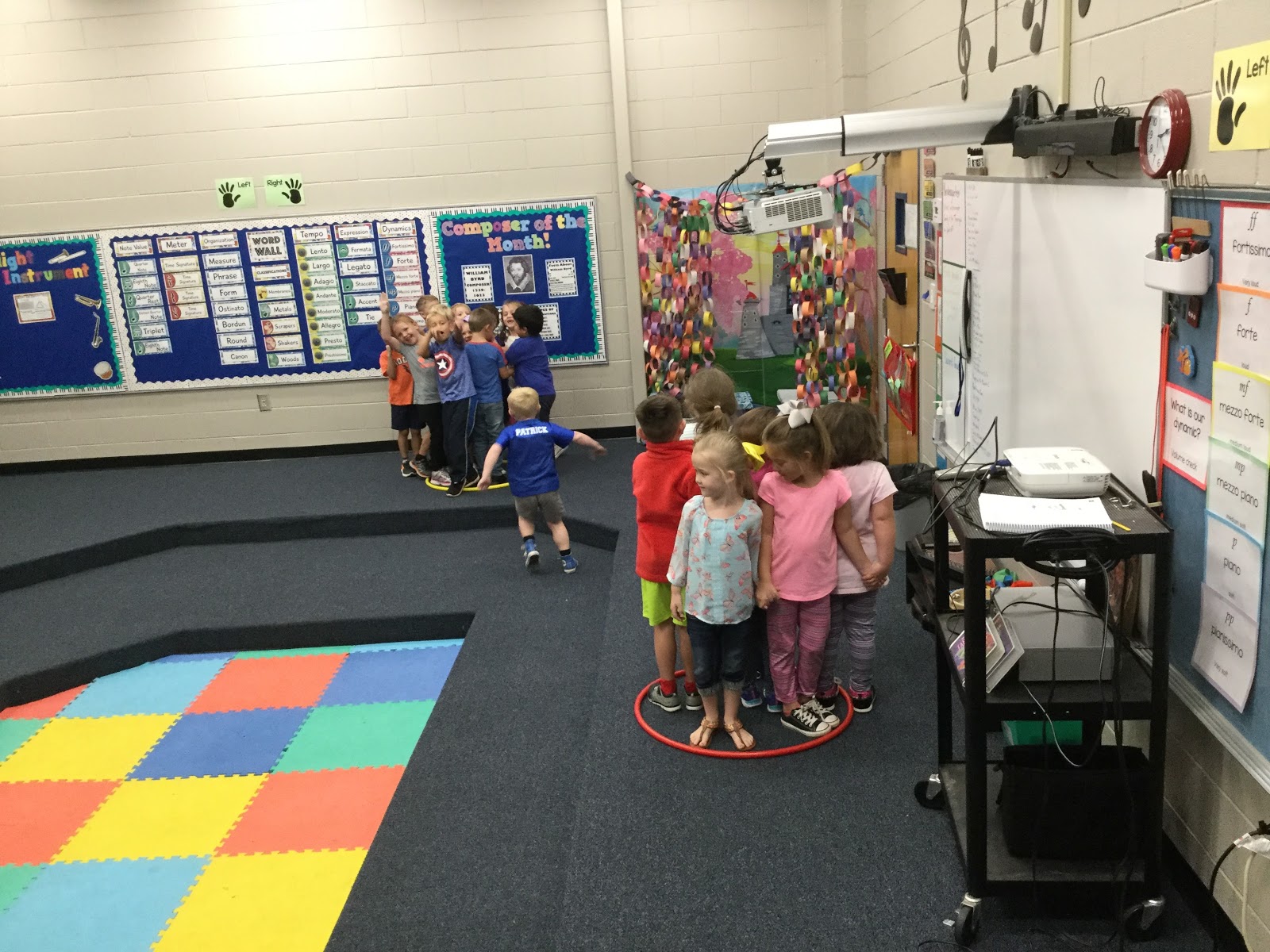
Here we have Kindergarten playing the game "Musical Houses and Families." Students 'drive' around the neighborhood of hula hoops while the music plays. When the music stops, they must go to the nearest 'house' (hula hoop). The people within their hula hoop become their family, and from then on they must drive staying connected to their family. I take a hula hoop away each time the music stops until there is only one left, and we all become one great big family! This activity is great for kids who have a hard time moving around a space without bumping into others and things, and allows for the great community aspect of music to take affect!

Here is first grade playing Freeze Dance! When the music stops, they have to freeze in whatever shape the stick figure on a card I hold up is making! This really allows for the students to discover what kinds of ways their bodies can move, and allows for some laughs for all of us!
Friday, August 25, 2017
Second Grade Student Growth Measures
For the past 2 weeks we have been taking a pre-test in 2nd grade music called a Student Growth Measure. This pre-test was over information that we will be learning this year, to judge where students are on the knowledge scale for this information. At the end of the year, they will be taking it again as a post-test to see if they learned the information throughout the year as thoroughly as they could! So, if your kiddos have been complaining about tests in music, this is what they were doing! But don't worry, we're getting back to the fun now that testing is coming to a close! I cannot wait to teach your awesome kids these awesome new music concepts this year.
While we are testing and you wonder, "Why do my kids have to test in music? Isn't it just a fun place to sing and dance?" Remember that music has many health benefits for you and your children, and is an integral part of our lives. Look at these awesome research-based facts about the benefits of music!
While we are testing and you wonder, "Why do my kids have to test in music? Isn't it just a fun place to sing and dance?" Remember that music has many health benefits for you and your children, and is an integral part of our lives. Look at these awesome research-based facts about the benefits of music!
Subscribe to:
Posts (Atom)